IAM.Voice
Voice agents, scenarios, campaigns and operator hand-off.
Key capabilities
- Inbound and outbound voice scenarios
- Streaming ASR/TTS, barge-in and scenario engine
- Campaigns, telephony and operator hand-off
Step-by-step guides
Use cases
Start with the outcome: open a guide, prepare prerequisites, follow the steps and verify the success signals.
01 Take over from a voice agent and complete the callThe operator sees customer context, transcript and hints, then records the outcome in wrap-up.
- Audience
- Contact-center operator
- Outcome
- The operator sees customer context, transcript and hints, then records the outcome in wrap-up.
Before you start
- Connected operator workspace
- Active queue
- Configured handoff scenario
Steps
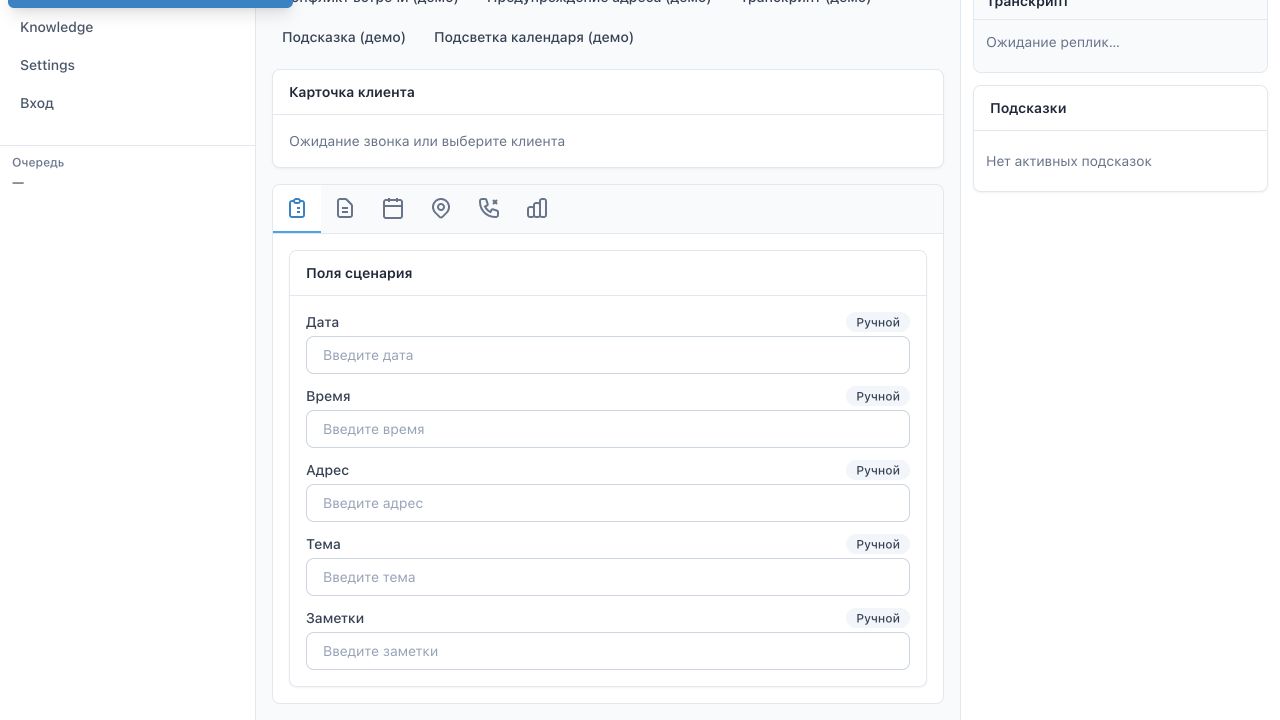
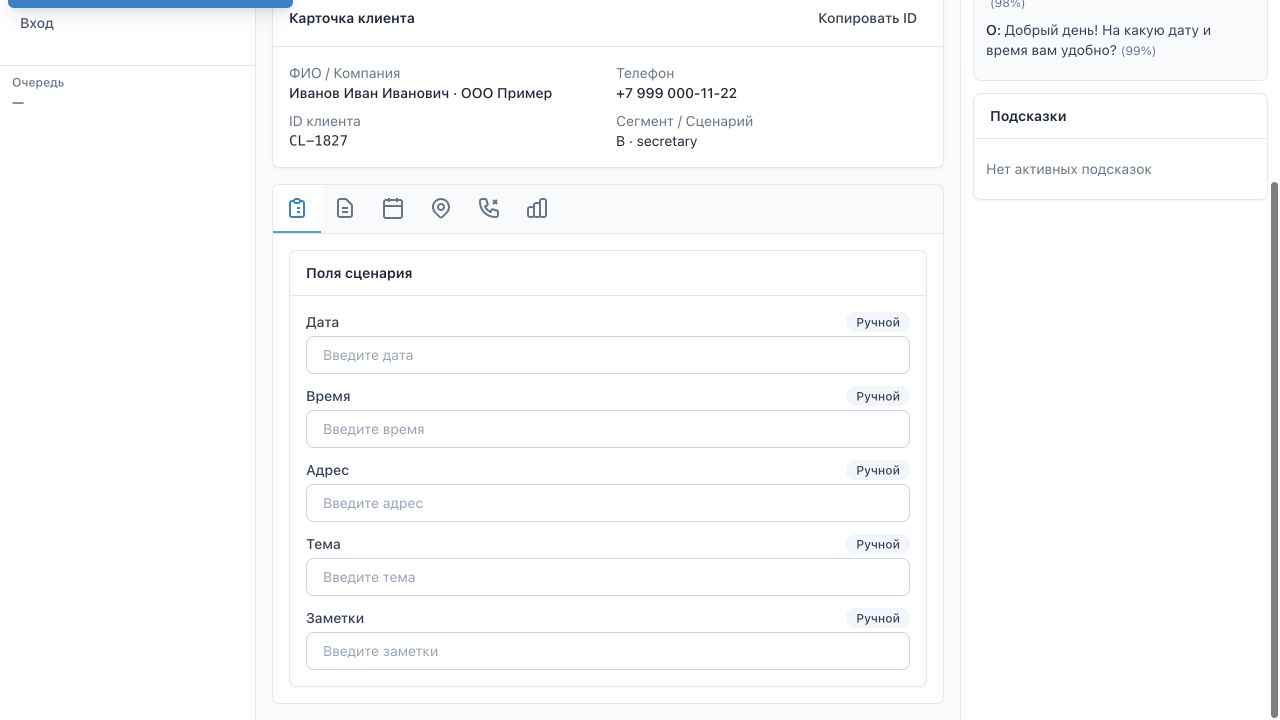
- Accept the customer cardVerify customer, segment and scenario before continuing the call.
- Follow the transcriptCopilot shows utterances and confidence; confirm low-confidence data.
- Complete scenario fieldsEnter date, time, address and notes; provenance distinguishes manual and AI values.
- Complete wrap-upSelect outcome, disposition and follow-up before closing the card.
Step screenshots

Video guide
The frames follow the sequence above; every screenshot caption names the state to verify.
Media provenance: Captured on 6 August 2026 using production demo controls; the customer card and transcript are synthetic.
Call history contains transcript, fields and wrap-up under one call id.
If the card desynchronizes, do not reload; reconnect WS and keep the call id.
02 Launch an outbound campaign with time and consent controlsCalls run only in allowed windows and escalate according to policy.
- Audience
- Campaign manager
- Outcome
- Calls run only in allowed windows and escalate according to policy.
Before you start
- Approved contact list
- Scenario version
- Calling hours and retry policy
Steps
- Create a campaignSet tenant, caller id, timezone, calling hours and max attempts.
- Upload contactsVerify consent status, suppression list and deduplication.
- Select the scenarioPin the version and operator handoff conditions.
- Start with a small batchVerify connection, ASR/TTS, outcomes and stop conditions before full scale.
Campaign metrics separate answered, failed, suppressed and escalated without duplicate contacts.
If failures spike, pause the campaign and inspect trunk/provider instead of increasing retries.
Open detailed manual
Every application screen has a separate page with controls, safe example values, CLI/API alternatives and status-specific recovery steps.
Role in the ecosystem
IAM.Voice manages incoming and outgoing voice scripts. It connects telephony IAM.Comm, streaming speech components, dialog logic and operator hand-off in one observed scenario.
Main scenario
- Configure the number, trunk and valid communication hours.
- Collect the script: greeting, intent, actions and transfer conditions.
- Select the ASR/TTS profile and check the delay on a test call.
- Launch an inbound flow or a coordinated outbound campaign.
- Analyze the outcome, reasons for termination and quality of the dialogue.
Real-time circuit
VAD determines speech boundaries, ASR generates a streaming hypothesis, the script selects next action, and TTS returns audio. Barge-in interrupts synthesis when speaking user. The timeout of each stage is limited so that the AI provider does not fail kept the call unanswered.
Data and security
Recording, transcription and personal data are included in accordance with the policy and consent. Contact lists are not mixed between campaigns/tenants. The operator receives the transfer context without provider credentials and hidden service instructions.
Analytics
For in-depth transcription, diarization and QA, recordings are transferred to IAM.Speech with the same correlation id.
Verified entry points
- Landing
- https://iamvoice.ru/en/
- Application
- https://app.iamvoice.ru/
- Portfolio
- https://iamgroup.ru/en/